Building a C++17 HTTP Server with Linux epoll
Hello! This is going to be my first post on my blog. I aim to occasionally blog some of my projects, contributions, specifics of my setup… in order to reflect on what I learned and hopefully keep a log I can go back to in the future. This is also a way to keep my communication skills sharp by finally writing something without AI assistance.
The Project
This post is going to be about my custom HTTP server implementation. When I started this project I was already familiar with the basics of Operating Systems (POSIX threads, system calls, etc.), and I was already falling in love with Networking as one of the most interesting parts of Computer Engineering in general. I always liked fast code and getting to know internals, and I figured trying to understand the logistics of one of the most used protocols in the world, and trying to do it fast, could be great practice.
At the same time, I also wanted to learn modern C++ (move away from C +
classes). As this was a learning project, I avoided the use of AI (although I
did use it in a moment of weakness, I admit) or specific guides online, trying
to just learn about the basics and then implement my own server as I saw fit.
My main source of documentation was man and cppreference.
The Interface
What I had in mind was a library that would make building your own custom HTTP
behavior a breeze. I imagined a user that just wants to build functions for
endpoints that get a HttpRequest and return a HttpResponse, and forget
about the rest. I had already decided I would use this library to implement a
PasteBin-like server (as it is useful and stylish to have your own for IRC
conversations), but the library itself is the focus, not what I built with it.
So now the interface for this library seems kind of clear. You create a server, you assign endpoints (either specific or wildcard paths) to custom functions and you run it. A specified signal (SIGINT or SIGTERM, for example) gracefully shuts it down.
This is how the pastebin application uses the library:
// src/main.cpp
HttpServer server(port, n_threads);

server.addEndpoint("/health", status);
server.addEndpoint("/", root_endpoint);
server.addEndpoint("/paste", handle_paste);
server.addEndpoint("/p/*", show_paste); // Wildcard support

server.serve(stop_signal);
There were a lot of challenges in this project. Some that I will not go into:
- Implementing a RAII TCP Server
- How excruciating and boring parsing logic can be, despite how fun state machines can appear.
- Support for partial reads.
- Plenty of debugging with GDB.
- Specific decisions regarding epoll (such as
EPOLLET). - Docker and deployment specifics.
The epoll Architecture
So the main problem with a server like this, or better yet, the main problem with networking, is that you have to do MANY tasks that are VERY concurrent (say, attending many independent requests at the same time) that include a lot of waiting. Usually the time it takes information to travel through the net is orders of magnitude longer than the processing you have to do to it, so a naive implementation will lead to CPU cycles lost waiting for information to arrive instead of processing other requests.
To be more specific: Imagine we have one CPU thread, and we want to handle many
connections (thanks to UNIX philosophy, these connections are just file
descriptors for us, we can read from them when we receive information, and
write to them when we want to send information). Are we just going to be stuck
in a while (!received) loop until this connection sends us the request? Of
course not! What if while we are stuck on that loop another connection sends us
a request?
So what we want is the ability to wait on multiple connections at the same
time. Luckily, we have a way. Whenever we receive data through these TCP
connections, the kernel is going to have to move that data to the file
associated with that connection anyway, so there is a system call to tell the
kernel “while you are on it, wake me up when this connection gets data”. This
system call is epoll (or select, the older, slightly less cool
alternative).
So using this system call, we decided this architecture:
- Only the main thread waits on
epollfor any updates. - The main thread will constantly accept new connections, and add them to our
epoll“waiting list”. - When the main thread sees activity on an established connection, it will send this connection to another thread to be handled.
- Many threads are just waiting on the
LockFreeQueuefor connections to be pushed.
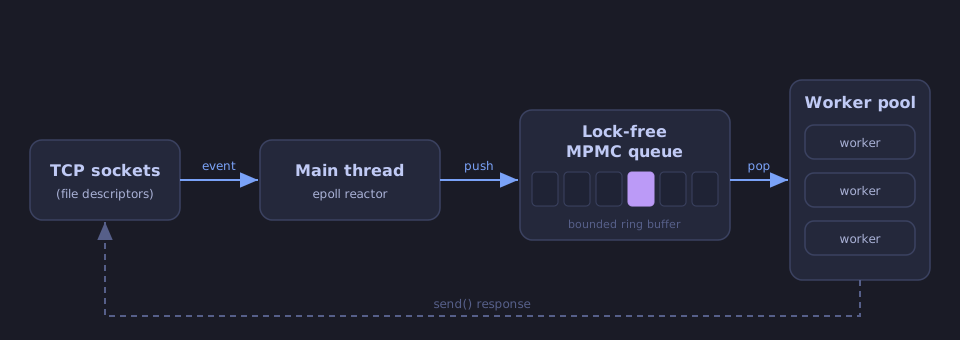
The key detail is EPOLLONESHOT: after a worker handles a connection, the
socket is removed from epoll until the worker explicitly re-arms it, so two
threads never parse the same fd at the same time:
// src/http/httpserver.cpp
// On a new connection
struct epoll_event new_ev;
new_ev.events = EPOLLIN | EPOLLET | EPOLLONESHOT;
new_ev.data.fd = new_fd;
epoll_ctl(epoll_fd, EPOLL_CTL_ADD, new_fd, &new_ev);

// After handling, re-arm so epoll wakes us on the next packet
struct epoll_event ev;
ev.events = EPOLLIN | EPOLLET | EPOLLONESHOT;
ev.data.fd = fd;
epoll_ctl(epoll_fd, EPOLL_CTL_MOD, fd, &ev);
As we have only one thread waiting on epoll, this is called a Reactor
Pattern. Another option would be having all threads wait on epoll
simultaneously, treating them as interchangeable workers rather than having a
dedicated dispatcher thread.
The coolest part? I didn’t realize at the moment, but now I realize what I implemented is a specific case of async programming. When I later learned about async in Python and in more modern C++, the internals were already there.
The Lock-Free Queue
Now let’s focus on another specific of the project: the LockFreeQueue. The
idea is easy: an interface for threads to push and pop connections to handle.
The only difference with a normal queue is the need for a blocking pop
operation, so that threads can passively wait for new content.
Originally this was a simple wrapper around std::queue, safeguarded by a
mutex to prevent race conditions. However, I revisited it later in order to get
something faster and more interesting.
The world of lock-free data structures is interesting and bigger than I imagined, but for this project I mostly followed the Ode to a Vyukov Queue post. It does a much better job explaining the algorithm than I would, so I will just describe the shape of the thing and how it fits the project.
The queue is a bounded MPMC (multi-producer, multi-consumer) ring buffer. Each
cell stores an item plus a sequence number. Two counters, top and bottom,
act as tickets: top is for consumers, bottom for producers. The sequence
number in each cell tells which side owns the cell at any moment. Because the
buffer size is a power of two, indexing is just counter & mask instead of the
naive counter % size. To avoid false sharing, top and bottom live on
their own cache lines:
// src/http/lockfreequeue.hpp
struct Cell {
    T item;
    std::atomic_uint32_t sequence;
};

std::array<Cell, Size> buffer;
alignas(64) std::atomic_uint32_t top;
alignas(64) std::atomic_uint32_t bottom;
To implement the blocking pop operation, I used a condition variable. The
interesting tension is that a truly lock-free queue cannot block, so the
“blocking pop” is a hybrid: the queue body is lock-free, but the sleep/wake
mechanism uses a mutex and a condition variable. The workers loop on
wait_pop(), executing tasks or exiting when shutdown sets the stop flag.
// src/http/threadpool.cpp
threads.emplace_back([this] {
    for (;;) {
        std::optional<std::function<void()>> task;
        task = queue.wait_pop();
        if (task)
            (*task)();
        else
            break; // End the thread
    }
});
The reactor thread pushes connection tasks with tp.addTask(...), and a worker
picks them up from the queue. It is not a perfect implementation by any means, but it is a fun excuse to learn about memory ordering and atomics.
A Debugging Journey: Nginx Hang
When I put the project online at paste.jesusblazquez.eu, I ran it behind
Nginx as a reverse proxy. Things seemed to work locally, but through Nginx the
POST /paste form submission would hang for seconds or time out.
The issue was response framing. My HttpResponse only emits a Content-Length
header when a body has been set:
// src/http/httpresponse.cpp
void HttpResponse::setBody(std::string body) {
    this->body = std::move(body);
    headers["Content-Length"] = std::to_string(this->body.size());
}

std::string HttpResponse::serialize() const {
    std::string ss;
    ss.append(getStatusText(this->code)).append("\r\n");
    for (const auto &p : this->headers)
        ss.append(p.first).append(": ").append(p.second).append("\r\n");
    ss.append("\r\n").append(this->body);
    return ss;
}
And serialize() just writes the status line, the headers, and the body. The
server never sends a Connection: close header and never implements chunked
encoding, so every response must be self-delimiting through Content-Length.
For POST /paste, the curl branch returned a plain-text URL, so setBody was
called and Content-Length was present. The browser branch, however, returned
a 303 redirect with only a Location header and forgot to set a body. No body,
no Content-Length, no Connection: close. Nginx therefore had no way to know
where the response ended, and would wait for more bytes until the proxy read
timeout hit.
The fix was one line:
// src/endpoints.cpp
response.setStatusCode(303);
response.addHeader("Location", url);
response.setBody("");   // <-- this
Calling setBody("") forced Content-Length: 0, which gave Nginx a clean
end-of-message. This is a good reminder that protocols only work when everyone
follows them: HTTP/1.1 requires every response to be self-delimiting, and local
curl tests can hide framing bugs that only a reverse proxy will exercise.
Performance
I run wrk -t4 -c100 -d10s against a local instance, client and server sharing
the machine: an Intel Core i5-10210U (4 cores, 8 threads).
| Endpoint | Requests/sec | Transfer/sec | Avg latency | Total requests |
|---|---|---|---|---|
GET /health | 123,027 | 10.1 MB/s | 743 µs | 1,232,578 |
GET / (index.html) | 47,805 | 219.3 MB/s | 1.91 ms | 479,202 |
/health is the reactor and parser at their cheapest. / serves a file from
the page cache, so 219 MB/s is mostly memory bandwidth.
Next Steps
So, how good is this implementation? Pretty bad. I like the easy, fine-grained control the library gives. However, the implementation doesn’t even cover everything HTTP/1.0 has to offer.
It doesn’t crash or slow down under load (see Performance), but
it is still not fast. Still, the main problem with my server is the
system-call overhead. Further reading into modern HTTP implementations showed
me that the syscall-per-event model of epoll has a real cost, and newer
designs try to avoid it. This approach needs many system calls when processing:
For waiting, we use epoll_wait, when we get the descriptor for the pending
connection, then we recv the information and parse it. Finally, we send it
back. System calls are notoriously expensive as they require a context switch,
and this is just to move information from kernelspace to userspace
(that is what recv and send are actually doing). Why bother?
The modern solution is io_uring, which allows us to batch our submissions. It
is out of the scope of this blog and project, but in short it just means having
shared queues with the kernel:
- The Submission Queue (SQ): In which you put I/O requests. For example: “I want to read from X into buffer B, I want to send what’s in buffer A to Y”
- The Completion Queue (CQ): In which the kernel tells you “X says B’s content to you, you successfully sent A’s contents to Y”.
In these two examples, A and B are located in buffers in your application memory space, so transmitting this data from kernelspace to userspace requires no system call. With this, it is easy to see how one can turn 5 I/O requests into what is essentially pushing the 5 requests to the SQ and one system call to notify the kernel of the new submissions.
Vulnerabilities
From time to time I come back to this project and try to make it a little bit better. For example, during my internship at INSAIT, when I was learning about fuzzers, I tried to run it through a fuzzer. I found two vulnerabilities (no spoilers, but critical DoS ones); but then I thought: Why bother? These are great in case I ever do a follow-up workshop on Denial of Service, or fuzzing or something. Having an actual target can be entertaining for students doing this for the first time. As the deployment is safe, I would not get mad if someone were to crash my server, as long as it is a good learning experience.